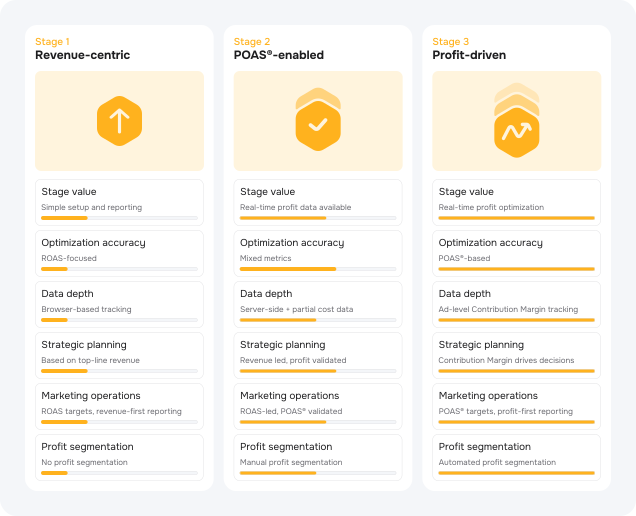
Our POAS® Maturity Model for E-commerce describes the journey a brand takes from a revenue-centric (ROAS) strategy, to one that’s truly profit-driven (POAS®).
Use it to determine where your company is now, and what steps you can take to become more profitable.
To learn more about POAS® and how it works, or to see the Agency version of this Maturity Model, take a look at our in-depth guide: Mastering POAS® in Google Ads.

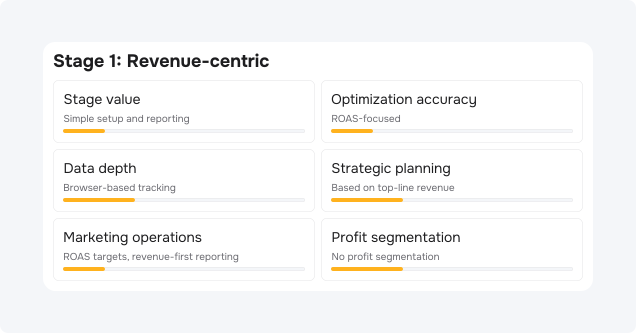
The company relies on ROAS as the key success metric. The focus is on driving top-line revenue, with the belief that strong revenue will lead to profitability.
Marketing
Leadership
Marketing
Leadership
The company can’t connect growth to bottom-line impact. Campaigns that look successful (based on revenue) may actually be losing money, while truly profitable campaigns may be overlooked.
Without profit visibility, inefficiencies compound. Leadership risks scaling a business that only works on paper.
Leadership starts investing in the infrastructure needed to track profit:
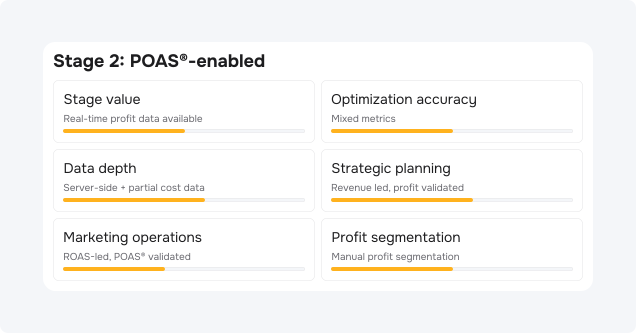
Tracking and cost data is in place for profit-focused campaigns. Infrastructure and behavior is evolving, but operations haven’t fully shifted away from being revenue-based.
Marketing
Leadership
Key available metrics
Marketing
Leadership
Scaling prematurely or reverting to ROAS-first thinking. Profit-first strategies need to show consistent results before adding significant investment.
At the same time, Marketing must stay committed to the new metrics during this transition, rather than defaulting to more comfortable ROAS-based strategies.
Marketing validates that profit-focused campaigns are outperforming ROAS-based campaigns in terms of Contribution Margin. The majority of the budget is reallocated and ROAS-based campaigns are deprioritized.
Leadership begins using Contribution Margin as the key factor in budget planning and forecasting.
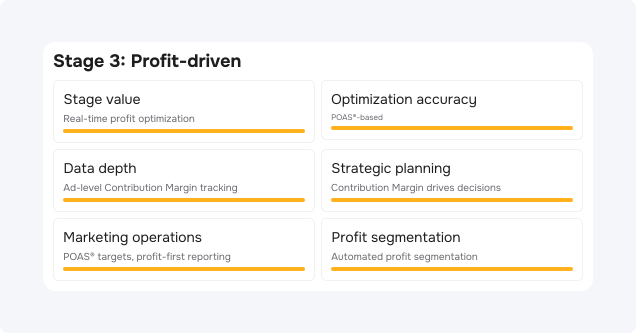
The company now uses profitability metrics as the core indicators of success. Company and campaign strategy revolve around improving Contribution Margin to grow sustainably.
Marketing
Leadership
Key available metrics
Marketing
Leadership
Setting and forgetting. When everything is based on profit, it’s easy to think the campaigns are done, but this is not the case.
Teams speak the same profit-first language, and the use of POAS® and Contribution Margin has been standardized for planning, execution and reporting.
Leadership is continuing to build and test a playbook of optimization strategies, based on this foundation.
This Maturity Model shouldn’t be seen as a strict set of rules, but as a path to progress your company toward greater profitability.
Most e-commerce companies fall into Stage 1, because revenue and ROAS were the focus for decades. We now have the tools and the data to strive for something more effective.
If you’re interested in learning more about POAS® and how your company can start focusing on profitable growth, take a look at our complete guide: Mastering POAS® in Google Ads.
Or sign up for our free email course for step-by-step lessons.
ROAS (Return on Ad Spend): The amount of revenue you get back based on ad spend. If you spend €100 on ads, and get €200 in Revenue, you have a ROAS of 2 (Revenue / Ad Spend). ROAS does not account for variable costs (Cost of Goods, shipping, packaging and handling, payment fees, discounts).
POAS® (Profit on Ad Spend): The amount of gross profit you get back based on ad spend. If you spend €100 on ads, and get €200 in Gross Profit, you have a POAS® of 2 (Gross Profit / Ad Spend). As POAS® is based on Gross Profit, it does account for variable costs.
Blended POAS®: The combined POAS® of all your campaigns.
CPA (Cost per Acquisition): The amount it costs to convert a first-time customer.
Contribution Margin: Gross Profit minus Ad Spend. This is your total profit before accounting for fixed expenses (employee salaries, rent)
Product segmentation: Separating products based on performance (ROAS, POAS®, Traffic) to run specific campaigns.
Get started today, no credit card required.

ProfitMetrics boosts your work with real-time profit insights on orders.