Jake Buckner
Author
Imagine a Google Ads campaign that generates two €100 orders.
One comes from a brand-new customer. The other comes from a customer who’s already purchased from you five times.
Inside Google Ads, those conversions can look identical. Optimizing around them as if they’re the same means teaching Google the wrong lesson.
When you teach Google the wrong lesson, it becomes remarkably good at delivering the wrong outcome.
The problem isn’t Google’s automation. It’s that we’re teaching Google to treat every purchase as equally valuable. If every conversion looks identical, Google has no reason to optimize for one outcome over another.
Changing the outcome starts with teaching Google the right lessons.
That’s exactly why we built Conversion Booster v2. It gives Google a better definition of success by combining more reliable tracking with richer conversion actions.
When you improve the quality of the signals you send to Google Ads, you change what the platform can optimize for. Conversion Booster v2 introduces new conversion actions designed to give Google’s bidding algorithms a much better understanding of what creates value in your business.
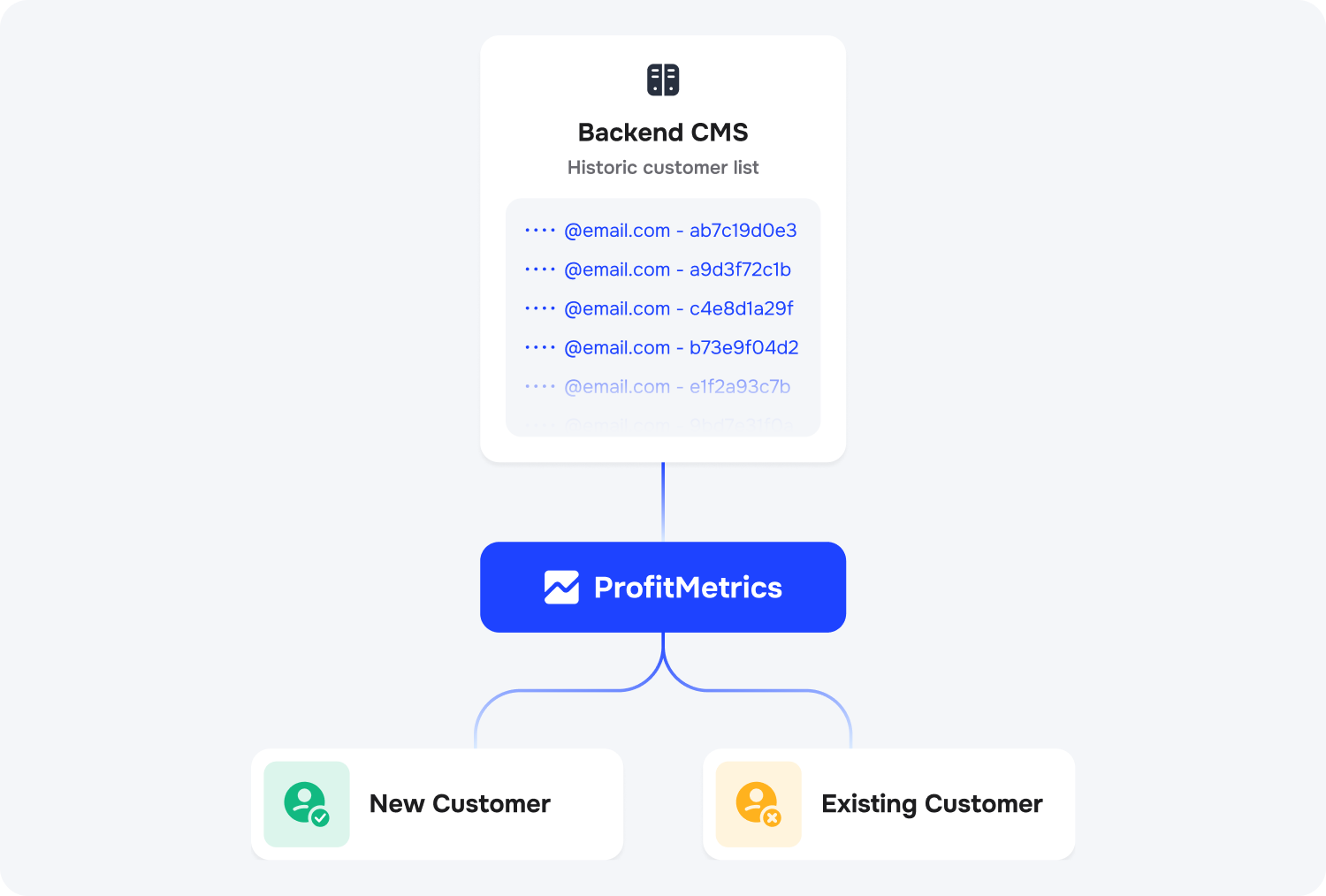
For almost every ecommerce brand, acquiring a brand-new customer is strategically more valuable than generating another purchase from an existing one. New customers represent genuine business growth and future revenue opportunities, not just another transaction.
Left alone, Google’s algorithm will naturally gravitate toward customers who are easier to convert. Existing customers typically have a higher likelihood of purchasing again and are often less expensive to reach, making it easier for campaigns to hit their target metrics. But when repeat purchases are mixed together with genuine acquisition, it becomes much harder to understand whether your marketing is actually growing the business or simply capturing demand that already existed.
Conversion Booster v2 creates separate server-side conversion actions for new and existing customers by matching purchases against your verified backend customer history. That gives you a much clearer picture of what your campaigns are actually driving while giving Google a more meaningful signal to optimize around.
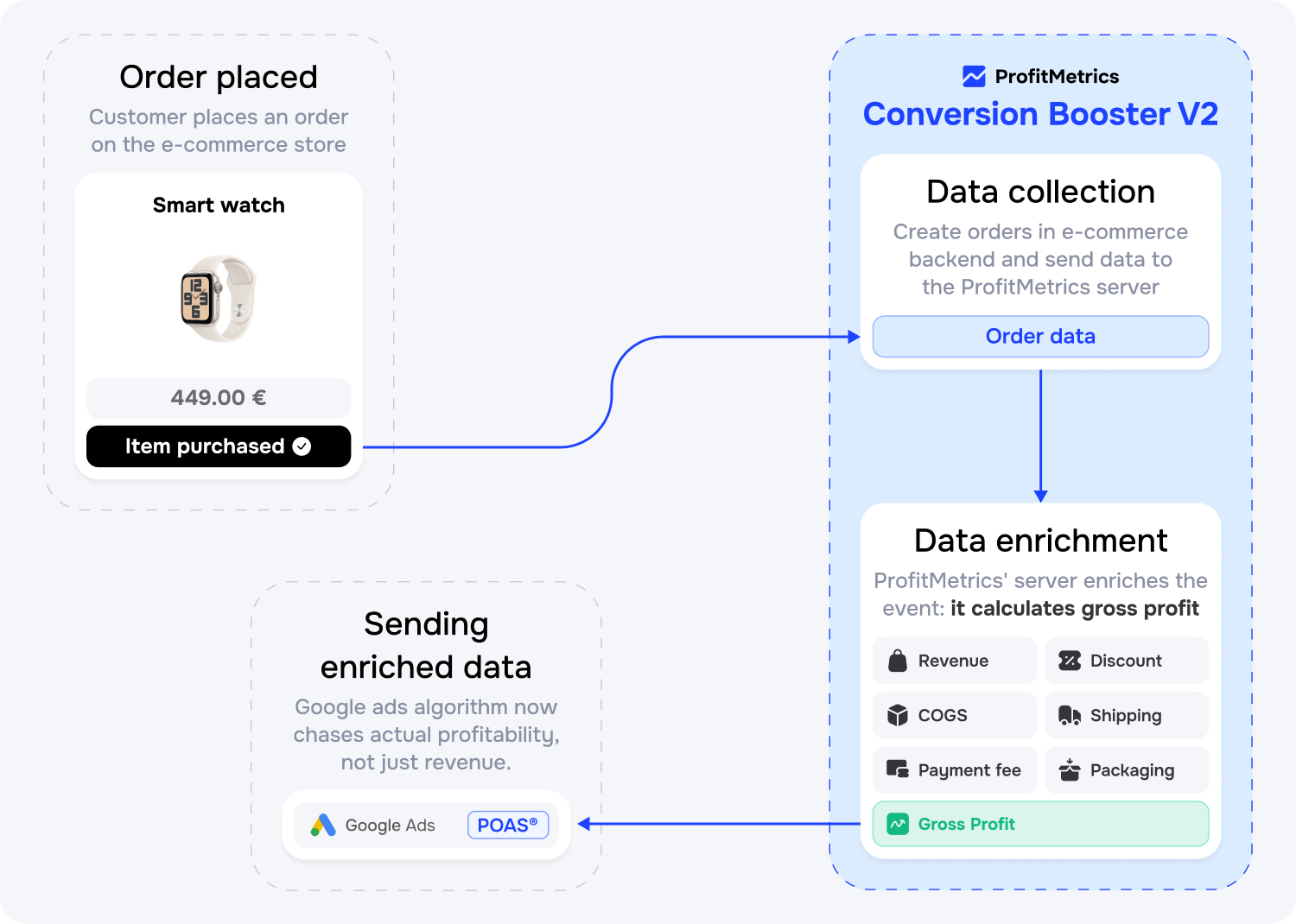
Revenue is still one of the most common conversion values passed back into Google Ads. Revenue alone, however, is a relatively blunt signal. Two orders may generate the same revenue while producing very different outcomes because of differences in product margins, fulfillment costs, payment fees, or long-term customer value.
If Google is going to optimize for value, the way you define that value to the algorithm is critically important.
Conversion Booster v2 expands the range of conversion actions and values available inside Google Ads. Within the ProfitMetrics platform, those signals can include profitability alongside long-term customer value, allowing bidding strategies to reflect a more meaningful definition of success than first-order revenue alone.
Put simply, ROAS tells you what you sold. POAS® (Profit on Ad Spend) tells you what you made. Even before moving to fully automated profit bidding, that visibility allows marketers to make better decisions about budgets, targets, and growth opportunities.

First-order reporting only tells part of the story.
Imagine two campaigns that each acquire a new customer with a €75 first order. On paper, they appear identical. But if the customer from one campaign generates another €200 over the following 60 days while the other never purchases again, those campaigns were never equally valuable.
Rather than relying on predictive LTV models, Conversion Booster v2 continues sending observed customer value back to Google over a 30, 60, and 90-day window. Once a new customer has been verified, subsequent purchases can be attributed back to the original acquisition, allowing reporting and bidding decisions to move closer to actual customer value, instead of just stopping at day-one revenue.
Advanced conversion actions are only valuable if the tracking behind them is reliable.
Many server-side tracking solutions still rely on a browser script firing on the thank-you page to complete the final handoff. If that script fails because of an ad blocker, a redirect, a slow-loading page, missing click parameters, or a user leaving before the page finishes loading, the conversion can still be lost.
Conversion Booster v2 approaches the problem differently. It collects order data directly from your ecommerce backend through native modules, apps, or APIs before sending it into ProfitMetrics.
Browser and server-side tracking work together, reducing dependence on any single point of failure. That foundation also supports features such as Consent Mode modelling and continuity when browser identifiers like GCLID, WBRAID, or GBRAID are unavailable.
Compared with typical server-side setups that still rely on thank-you-page scripts, this approach delivers an average uplift of 17% more tracked conversions. More complete data leads to more reliable reporting and provides a stronger foundation for advanced optimization.
Google can only optimize for the information it receives. If every business feeds it the same generic purchase signal, it can only deliver a one-size-fits-all solution. If you want a better fit, you have to give Google the measurements that matter to your business.
Better conversion actions lead to better decisions across your Google Ads account:
Better conversion actions give Google a clearer understanding of what success looks like for your business. That’s what Conversion Booster v2 was built for.

Get started today, no credit card required.

ProfitMetrics boosts your work with real-time profit insights on orders.