
Jeffers needed a better way to scale profitably across a large catalog. By implementing ProfitMetrics with support from Young & Digital and shifting from ROAS to POAS®, Jeffers gained the visibility needed to prioritize profitable products, make evidence-based scaling decisions, and align advertising performance with business outcomes.

Jeffers was already generating strong revenue when Young & Digital began managing the account. However, with a massive catalog and significant margin differences between their own-brand and 3rd-party items, revenue alone was no longer a reliable guide for growth.
Jeffers (jefferspet.com) is a long-established US-based retailer specializing in pet and equine supplies. With a catalog of over 26,000 products covering everything from everyday pet care to specialist equine and farm animal supplies, Jeffers serves a broad customer base across both the consumer and professional markets.
Young & Digital is a Google Ads agency specializing in helping ecommerce brands scale profitably. Since its founding in 2020, the agency has managed more than £83 million in advertising spend and generated over £450 million in Google Ads revenue for its clients. As more brands sought to optimize for profitability rather than revenue alone, ProfitMetrics became a key part of the agency’s approach.
Before implementing ProfitMetrics, Jeffers relied heavily on standard Google Ads reporting and ROAS targets to evaluate performance. While these metrics provided visibility into revenue generation, they offered limited insight into actual profitability.
This lack of profit visibility was compounded by the fact that Jeffers sold a complex mix of own-brand and third party products with significantly different margin profiles. A campaign could generate strong revenue while contributing relatively little to the bottom line depending on the products being sold.
Without access to order-level profit data, Jeffers lacked a reliable way to distinguish between high-revenue campaigns and genuinely profitable ones. As a result, important decisions around budgeting and bidding were often made without a complete picture of the account's financial performance.

“The client wanted to understand how much profit they were actually generating rather than relying on Google Ads ROAS.”

Liam Healey
Senior SEA Growth Manager
-
Young & Digital

Managing a catalog of more than 26,000 products spanning multiple categories and brands created a significant campaign management challenge.
Even when performance appeared strong, the team lacked a systematic way to prioritize products based on their contribution to the business. Budget was distributed across thousands of products with varying margins, making it difficult to ensure investment was flowing toward the products that created the most value.
Without a clear framework for organizing campaigns around profitability, product prioritization often relied on broad categorizations and manual decision-making.
Despite strong performance, Jeffers lacked the confidence to increase investment.
While campaign performance appeared strong, neither Jeffers nor Young & Digital had the evidence needed to clearly demonstrate the financial impact of additional investment. Without a reliable way to connect advertising activity to business outcomes, larger budgets were difficult to justify.
This uncertainty made it difficult to pursue growth opportunities with confidence.
The realisation was that we could see strong ROAS numbers but couldn’t confidently advise the client to scale spend, because we didn’t know which products were genuinely profitable. Across 26,000+ products, that uncertainty was the bottleneck on growth.
- Liam Healey
To gain a clearer understanding of business performance, Young & Digital implemented ProfitMetrics and shifted the account's primary performance metric from ROAS to POAS® (Profit on Ad Spend), which shows the exact profit returned for every dollar invested in ad spend.
Instead of evaluating campaigns based solely on revenue generation, the team could now assess performance based on real profit contribution. This provided a complete picture of which campaigns were actually creating value, as opposed to those simply creating volume.
The shift fundamentally changed how accounts were managed. Budget allocation, bidding strategies, and campaign evaluations were no longer tied to top-line revenue, but to the financial outcomes those campaigns generated.
It fundamentally changed our decision-making. Before POAS, budget was allocated based on Google Ads ROAS, a number that includes brand traffic, ignores product margin, and treats every order as equal. We used to have to segment campaigns by e.g. type of reseller brand, product type, and other factors where we relied on the client’s input rather than having clear insight into what is driving profitable growth.
- Liam Healey
To address the complexity of the 26,000+ SKU catalog, Young & Digital used ProfitMetrics' Shopping Booster to build campaign structures around profitability.
Products were automatically segmented into categories such as highly profitable, profitable, unprofitable, and no-traffic products. This allowed the agency to create dedicated campaigns and bidding strategies based on actual profit performance rather than relying on broad, manual product groupings.
By restructuring the account around profitability data, the team gained significantly greater control over budget allocation and ensured that advertising investment flowed toward the products contributing most to the bottom line.
With profitability data available across campaigns and products, Jeffers and Young & Digital could move beyond assumptions and support recommendations with concrete financial evidence.
Instead of relying on revenue metrics, the team could demonstrate the exact profit contribution of individual campaigns and product groups. This transformed conversations around scaling from discussions based primarily on ROAS targets into discussions grounded in measurable business outcomes.
By replacing revenue-led assumptions with validated profit signals, both the agency and the client gained the confidence required to unlock aggressive, defensible growth.
The client originally had budget limitations that were holding back growth despite strong performance. We used consistent profit data and POAS evidence to give them the confidence to increase budgets, and the results justified it.
- Liam Healey
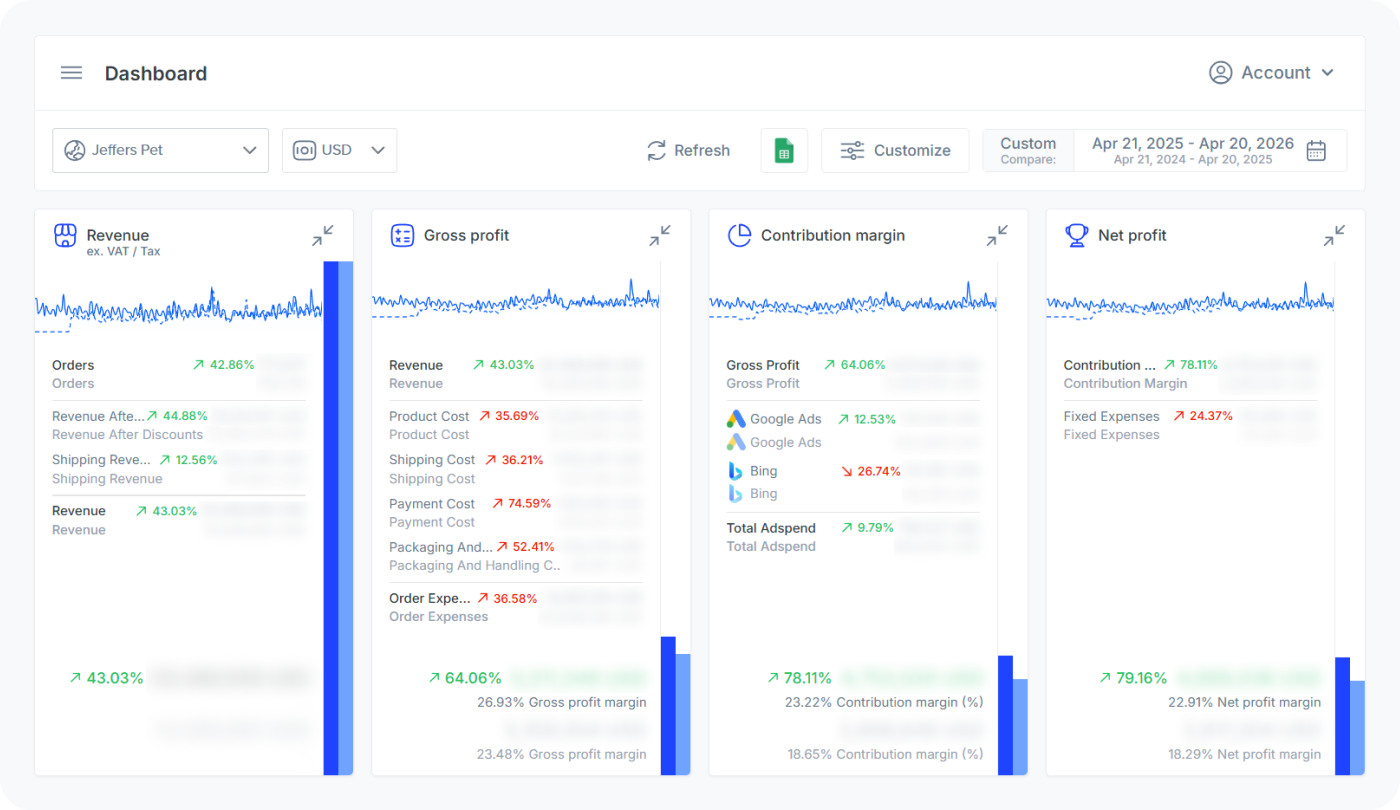
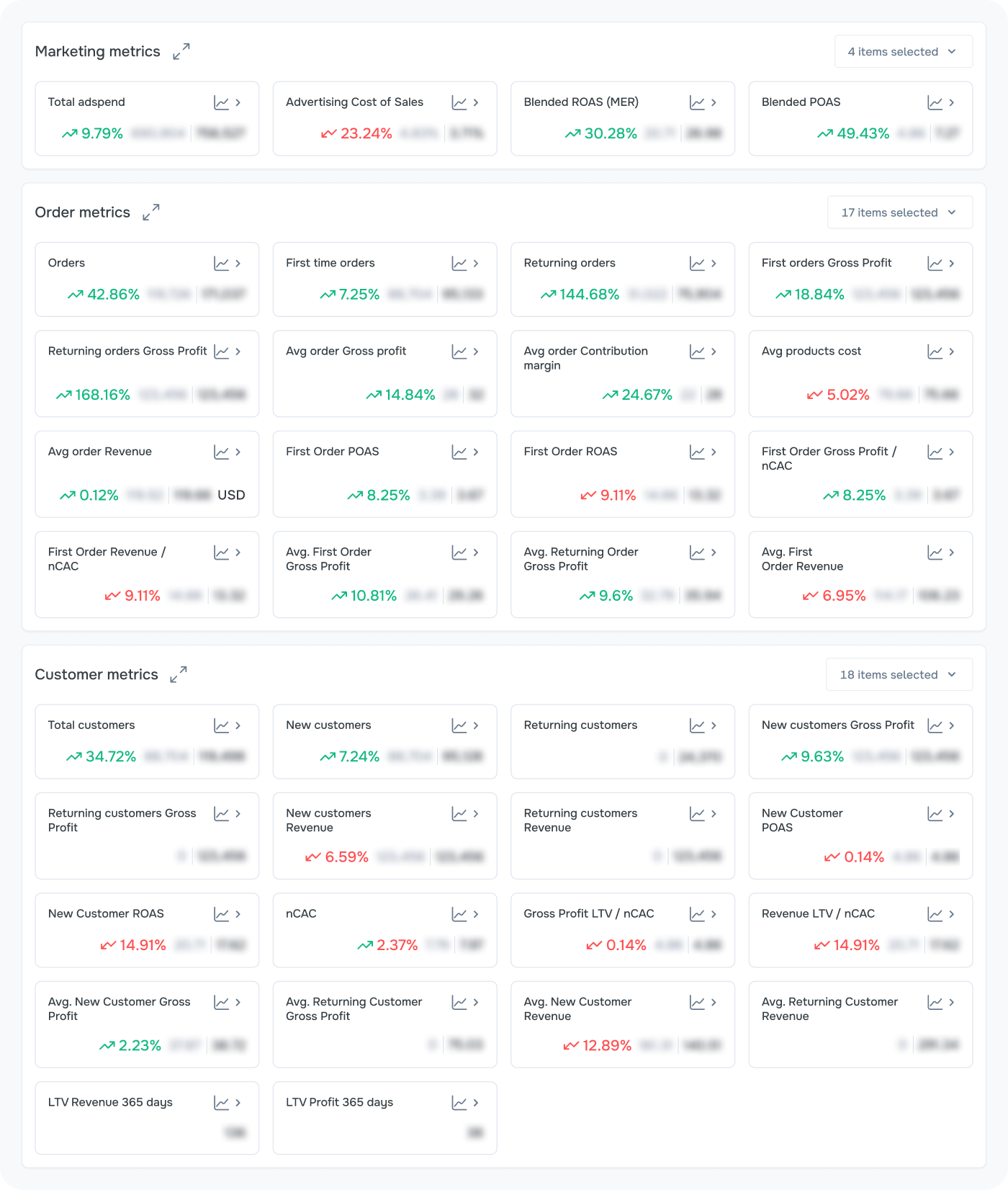
By shifting from ROAS-based optimization to POAS® and restructuring campaigns around profitability, Jeffers was able to grow more aggressively while maintaining strong efficiency. Net Profit increased 79% year-over-year while ad spend increased just 10%.
Year-over-year comparison: April 2024-April 2025 vs. April 2025-April 2026
The biggest benefit is being able to trust the numbers and the data we see. With every change we make, we can see the return and the profit it drives. That gives us confidence knowing our work makes a real difference, not just in the account, but in generating actual profit for our clients.
- Liam Healey



-
Learn more about our agency partnerships


ProfitMetrics boosts your work with real-time profit insights on orders.